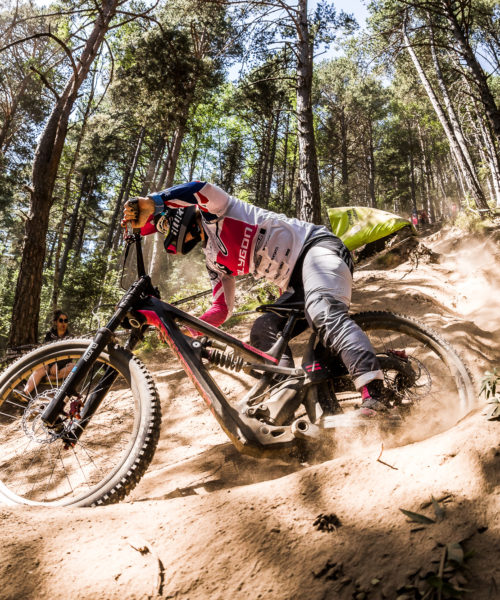
It has surely happened to you at some point: you’re descending at full speed, linking corners, squeezing every meter, or facing long, steep downhills, when suddenly the brakes start to fade. The lever pulls in further than usual, the feel changes, and a single thought pops into your mind: “What if I run out of brakes before I reach the bottom?”
Most riders have lived that moment. And that’s exactly when you understand why so many people switch from 180 to 203 or even 223 mm brake rotors.
What really changes when you move to 203 or 223 mm?
You feel it on the very first pull of the lever.
A larger rotor means more power without squeezing harder. Physics is on your side: a bigger diameter multiplies the force. With this upgrade you gain roughly 15–20% extra braking power, which translates into more safety and more control.
And it’s not just about power. The other big difference is heat management. With a 203 or 223 mm rotor you have more surface area and more mass to dissipate heat. That means less fading, fewer scary moments on long descents, and greater durability for both rotors and pads.
If you ride an e-bike or enjoy long, technical downhills, you’ll notice the improvement immediately.
The detail you must never forget: the adapter
Here’s the practical part. You can’t just fit a bigger rotor and call it a day. To position the caliper correctly you need the right post-mount adapter (Galfer’s 4-bolt adapters offer extra security), and you must remove your current adapter if you already have one installed:
- From 180 → 203 mm, you need the +23 mm (SB004).
- From 203 → 223 mm, you need the +20 mm (SB002).
- From 180 → 223 mm, you need the +43 mm (SB001).
- From 160 → 223 mm, you need the +63 mm (SB003).
Conversion table: https://galfer.eu/bike/products/accessories/
If you install the wrong adapter or leave the caliper misaligned, expect noise, vibration, and uneven wear. And that’s the last thing you want while descending hard.
Important: never stack two adapters together.
A tip between riders: take your time to center the caliper properly and make sure pads sit evenly. That moment in the workshop saves a lot of headaches on the trail.
Is this change for you?
It depends on your riding style:
- If you ride basic XC and prioritize weight, 180 mm is enough.
- If you ride enduro or DH, or love long descents, 203 mm is almost mandatory.
- If you descend on an e-bike or race DH, 223 mm is a strong recommendation.
If you’ve ever felt a spongy lever mid-descent or sensed your brakes giving up, then you already know the answer.
You can also mix sizes: a bigger rotor up front and a smaller one in the rear, depending on your needs.
In the end, it’s not about braking harder—it’s about braking better, with more confidence.
Which rotor should you choose?
Galfer offers several options to find your perfect match:
- Disc W Fixed 203 or 223 mm: lightweight, versatile — a simple and effective upgrade.
- Disc W Floating 203 mm: more stiffness, more thermal stability, plus colored pins for extra style.
- Disc Shark® 203 or 223 mm: top tier, engineered for extreme conditions and maximum heat dissipation.
Full lineup: https://galfer.eu/bike/products/brake-discs/
The real difference
Upgrading from 180 to 203 or 223 mm is simple, fast, and massively impactful. It gives you peace of mind — the confidence that your brakes won’t fail when you need them most. It lets you release the brakes a little more, hit the corners harder, and trust that when you pull the lever, the bike will respond.
Plus, your discs and pads will last longer because they’re not overheating as much.
Because in the end, that’s what it’s all about: feeling in control.
And when you’re in control, you enjoy the ride so much more.
So now you know: if you feel your brakes are holding you back, it’s time to size up.
Your future self on the next descent will thank you.